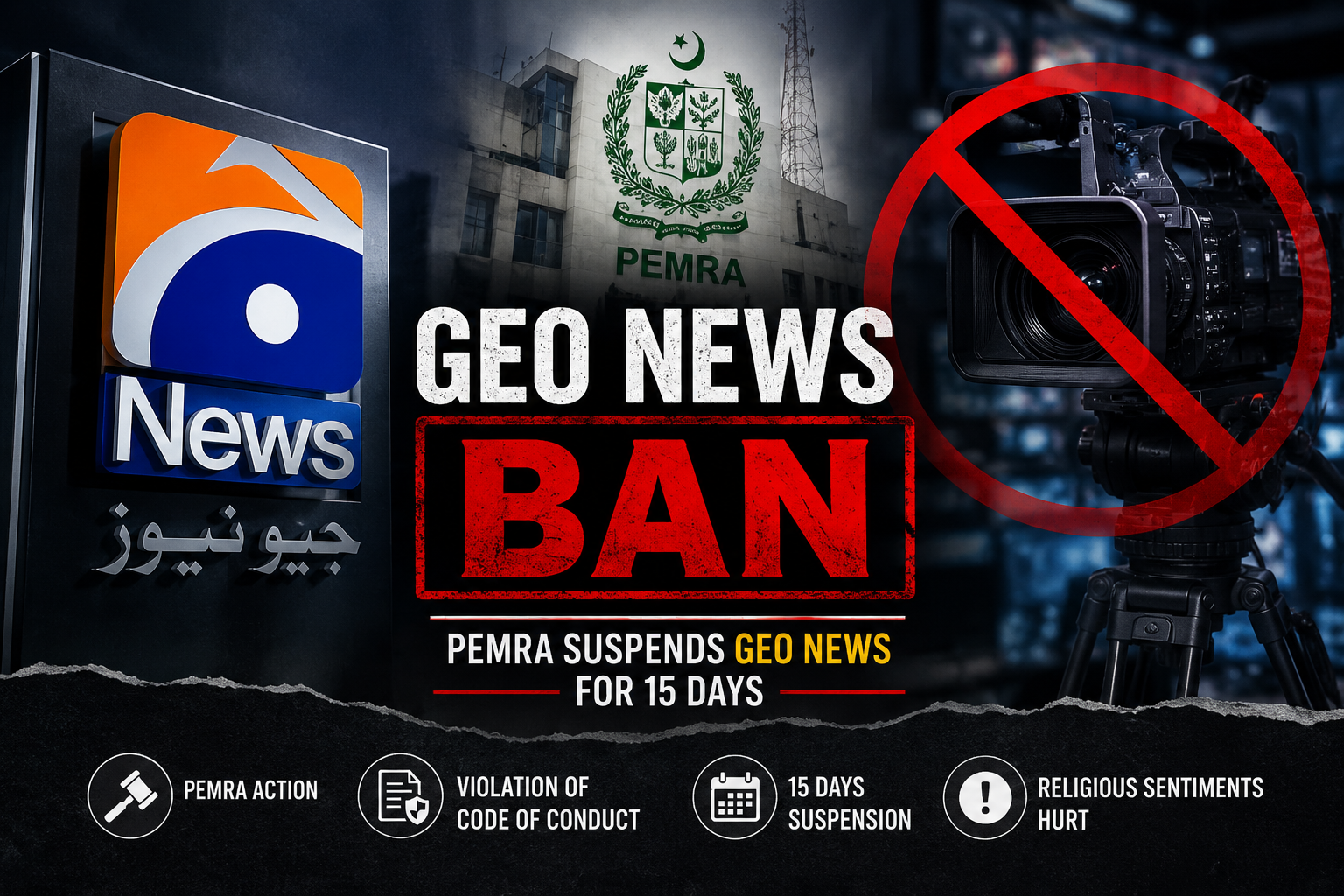
The Geo News ban has recently become a big media issue in Pakistan. PEMRA has suspended Geo News for 15 days due to its content.
The reason for this decision was the broadcasting of a special Muharram program that had controversial material. Moreover, the regulator has also been concerned about public peace.
Geo News is one of the leading private news channels in Pakistan that reports both domestic and foreign news. Consequently, any regulatory actions in relation to it attract public attention.
Why Was Geo News Suspended by PEMRA?
According to PEMRA, the decision was based on the broadcasting of a documentary Safar-e-Ishq that contained religious visualizations.
PEMRA believes that such content does not correspond to the necessary standards. Pakistan is a country with a high level of religious, cultural, and social sensitivities. Consequently, broadcasters have to be extra cautious when producing religious programs.
Moreover, the regulator claims that the materials could offend viewers and affect public peace. For this reason, PEMRA decided to introduce the Geo News ban for 15 days.
The decision affects the satellite transmission and other licensed distribution systems. The regulator has also instructed the broadcaster to conduct an internal investigation.
Geo News Statement
Geo News has later issued an apology and admitted that there was an editorial error.
According to the channel, the footage depicted religious rituals that happen in Iraq and other Middle Eastern countries. Geo News does not support any particular religious belief. Consequently, Geo News immediately removed the disputed footage from its digital platforms.
The channel also said it took disciplinary action against the employees involved in the case.
Public Reactions to the Geo News Ban
The **Geo News ban** has led to different opinions among the public. Some people claim that news channels have to have strict editorial policies in terms of broadcasting religion.
Other people have raised concerns regarding the question of media freedom. Reporters and supporters of media rights think that regulatory decisions should be fair and clear.
Impact of the Geo News Ban on the Media Industry in Pakistan
The incident can make Pakistani television networks develop their editorial policy.
Media organizations can conduct additional content checks before broadcasting religious programs. Moreover, they can conduct additional trainings for journalists, producers, and editors.
In addition, live broadcasts might receive more attention since mistakes can appear before a huge audience instantly.
The case has shown that it is very important for news organizations to be responsible in providing information while meeting all the regulations and public sensitivities.
What Happens Now?
The 15-day suspension will remain in force as long as the PEMRA has ordered. Geo News will be able to continue its regular broadcasting after the expiration of the suspension period if it follows the instructions of the regulator.
PEMRA may also review the results of the channel’s internal investigation. The regulator can conduct some further actions depending on the outcome of this investigation.
Why the Geo News Ban Is Important
The Geo News ban is important for the discussion of two key topics: media regulation and freedom of speech.
Firstly, Pakistani media outlets must handle religious content with caution. Secondly, regulatory decisions should be consistent and clear.
It is important to mention that the case proves why it is necessary for TV networks to have strict editorial policy. Additional review of content can avoid mistakes.
Conclusion
The Geo News ban is an important media story in Pakistan. PEMRA has stated that the suspension has happened due to the broadcasting of the content that could insult religious feelings and disturb public peace.
Geo News has apologized for the error and removed the disputed footage from its digital resources. Moreover, the channel has disciplined the employees involved in the process.
It is possible that the incident will encourage Pakistani broadcasters to develop their editorial policy.