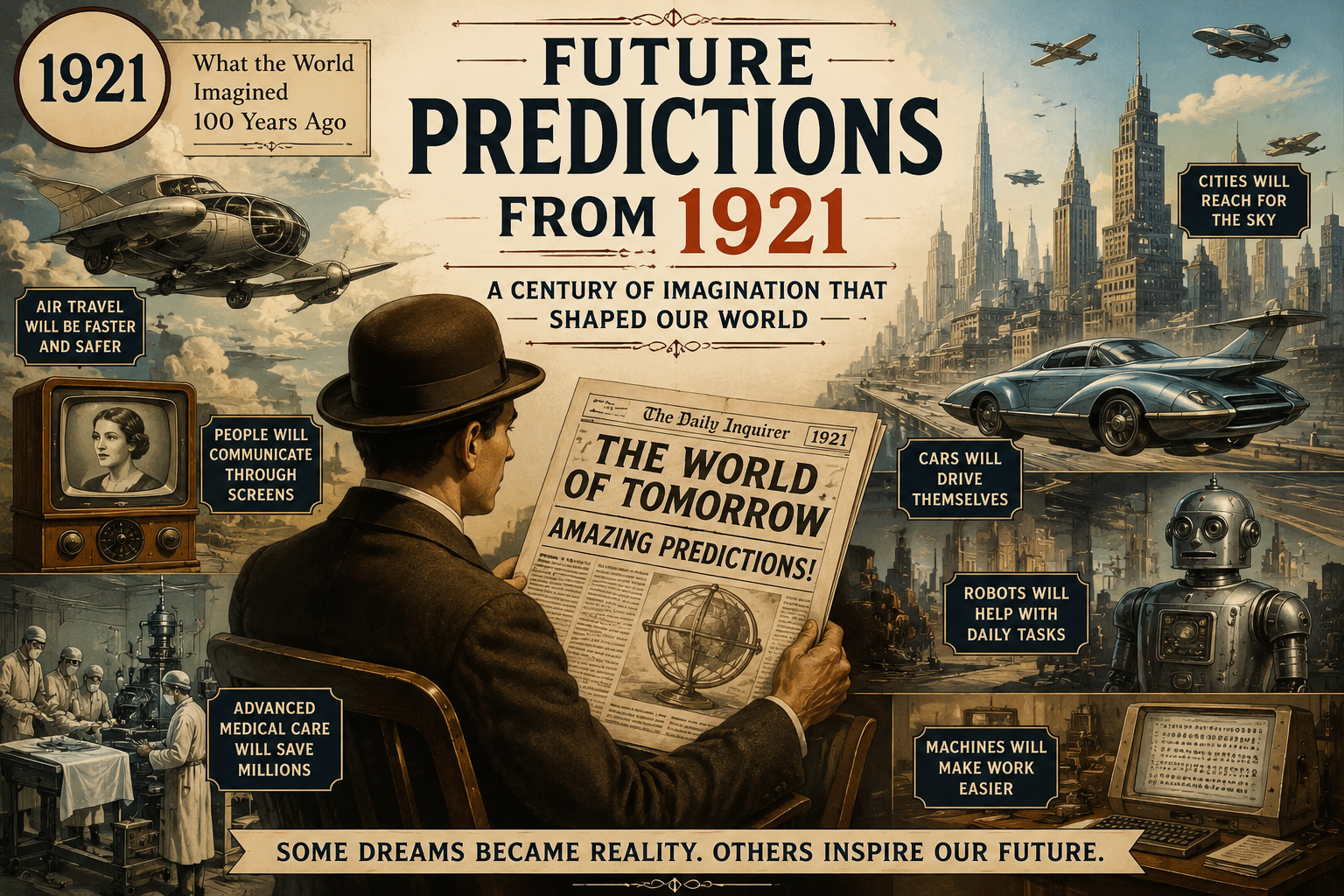
The year 1921 was filled with imagination and scientific curiosity. Inventors, writers, and researchers shared bold Future Predictions about how technology and society would evolve over the next century. While some ideas seemed impossible at the time, many eventually became part of everyday life, showing how powerful human vision can be.
A Century of Imagination
After World War I, optimism about science and innovation grew rapidly. Newspapers and magazines often published Future Predictions describing faster transportation, wireless communication, advanced medicine, and automated machines. These ideas encouraged people to dream about a better future driven by technology and progress.
Predictions That Became Reality
Many of the predictions made in 1921 were surprisingly accurate. Visionaries imagined wireless communication, which resembles today’s smartphones and the internet. They also predicted significant advances in healthcare, transportation, and household technology. Looking back, these Future Predictions demonstrate how imagination often inspires real scientific breakthroughs.
Predictions That Never Happened
Not every forecast became reality. Some believed that flying cars, underwater cities, and fully automated homes would become common by the twenty-first century. Although technology has advanced dramatically, many of these concepts remain experimental. Even so, these Future Predictions continue to inspire inventors and encourage people to think beyond current limitations.
What We Can Learn Today
History shows that predicting the future is never easy. Some forecasts become reality, while others remain dreams. Modern experts now predict advances in artificial intelligence, renewable energy, robotics, and space exploration. Just like the thinkers of 1921, today’s innovators are shaping tomorrow through creativity and scientific research.
Conclusion
The remarkable ideas shared in 1921 remind us that imagination is often the first step toward innovation. Some forecasts proved accurate, while others remained fictional, but each reflected humanity’s desire to improve the world. These Future Predictions continue to inspire new generations to explore possibilities, embrace innovation, and build a better future through science and technology.